
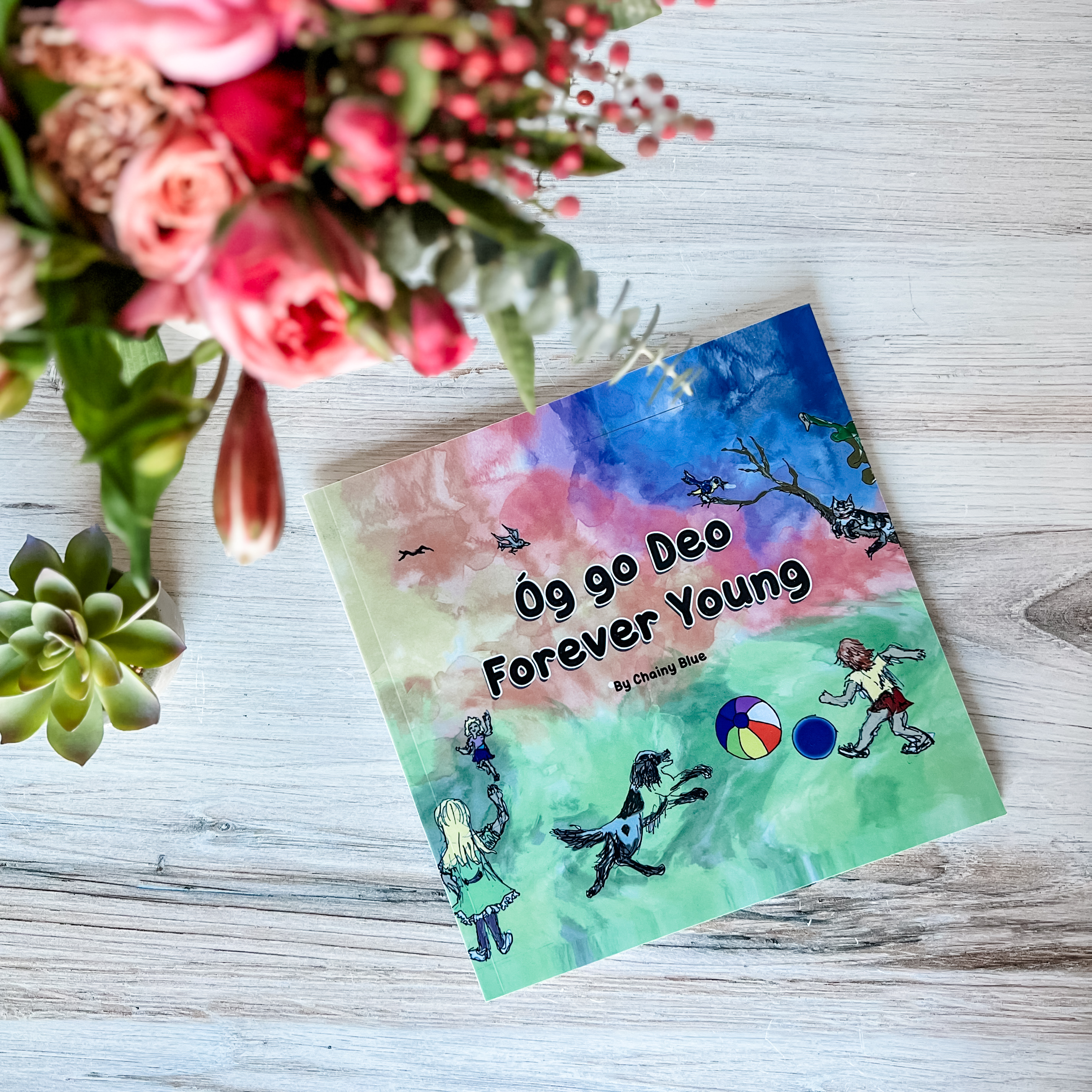

Today, I have the pleasure of interviewing Chainy Blue, the talented author behind Óg go Deo, a heartfelt and enchanting story that weaves together themes of love, loss, and the magic of the afterlife. This beautifully crafted tale takes readers on an emotional journey, exploring the bond between humans and their beloved pets in a world where love never fades.
The title Óg go Deo, meaning “young forever” in Irish, reflects the timeless connection we share with those we love, even after they’re gone. With its stunning imagery, rich cultural influence, and deeply comforting message, this story has touched the hearts of readers of all ages.
Join me as we dive into the inspirations, cultural roots, and creative process behind this unforgettable tale. Let’s hear from the author about the magical world of Óg go Deo and the love and light it brings to readers everywhere.
Óg go Deo Forever Young: Book GiveawayQuestion:
What inspired you to create the magical world of Óg go Deo, and how did you develop its unique details, like the Guardians and their enchanting qualities?
Answer:
The loss of a pet is often the first time a child has to come to terms with the death of a living animal they love. This physical world is transient—everything dies—but we know very little about death, and we are not very good at dealing with it.
Pets are innocent and trusting, and owners, whether children or adults, form a unique bond with them—unconditional love. They want to protect, care for, and interact with them, and then they die. Children are told they go over the rainbow bridge—and that’s it. Or they are stars, or in pet heaven. Confusing? Yes.
I went to a Catholic school and was told in no uncertain terms that animals had no souls. I was very young and very, very upset by this because I knew it was a lie.
There are basically two schools of thought:
1. There is no afterlife.
2. There is one.
If 1) is correct, then there is no Creator, and death is the end. But science cannot explain the universe without a Creator being involved (another of my questions in science class, as matter cannot be created or destroyed but only changes from one form to another—so where did all the matter come from before there could be a Big Bang?). So, I opted for a Creator and an afterlife for all.
I have had the privilege of talking to many people who lost their pets, and the stress and anxiety it causes because they don’t know what has happened to their souls. So, I have read the Bible, the Torah, several books on out-of-body experiences, spoken to patients who have had near-death experiences, etc. Religious interpretations of ‘Heavens’ are not ubiquitous, nor are they perfectly suited to all—in fact, most are quite lackluster and boring.
This world dies, but life doesn’t. The afterlife is incredible. No bodies to carry around, no pain, no physical needs—nothing like what we now know and experience.
We all need a Guardian to show us the ropes, and animals need to see their Guardians too, as they don’t seem to follow any dogma. Humans need to know their pet has a Guardian. Seeing them all the time would be too distracting. Animals feel safer with their own kind, so Guardians look like them.
Humans are very limited in what they can see on the light spectrum—unlike animals, who can see ultraviolet and polarized light. So, animals see the Guardians as they would expect to see them. Guardians have one role: to always be with their charge.
Óg go Deo is a vast spirit world, and I only wrote about a small part of it. Every animal has its own version of the world. Anyone who reads my book, I hope, can put their pet into the story and create a spirit world that would suit them.
I tried to design the story so it encourages the reader to tell their own story.
Question:
Miew-Miew’s story is both heartwarming and heartbreaking. How did your own experiences with pets influence this narrative?
Answer:
I got my first kitten when I was about five. I loved him so much. One evening, he never came back. My parents told me he got married! I was heartbroken.
A few years later, I asked about him again, and I was told that a neighbor’s car had killed him. That was so much worse—he was dead, and I had been lied to. My little heart was broken for the first time.
As an adult, when my youngest daughter was about two and a half years old, I decided to get her a kitten. From there, I rescued a few more abandoned or broken cats. When we moved house, there were feral cats in the area that were being poisoned, so I spent time trapping them and getting them neutered. Most remained wild and hung around the garden to be fed, but a few came inside towards the end of their lives.
Occasionally, very sad or abused cats would show up. They all had their own stories—some not very nice ones. I used to call them Miew-Miew until we decided on a name for them.
Miew-Miew is many cats.
Question:
The themes of love, loss, and the afterlife are central to the story. What message do you hope readers, especially children, will take away from these themes?
Answer:
Death is not the end—it is only the beginning.
Unconditional love is what we receive from animals. They teach us so much: love, trust, how to care for others, and that betrayal deeply hurts and breaks the trust they place in us. Animals are innocent and only expect us to love them in return.
Loss is both an emotional and physical experience, even for a child, and parents need to address this openly. The love of an animal is special and enriches the lives of humans—but they will eventually leave us to go to a special place.
We will miss them deeply, but their absence gives us the chance to give a home to another pet in need. If we want to see them again, we must live our best lives and always be respectful to animals.
Question:
Óg go Deo is described with vivid, imaginative landscapes. Did you draw inspiration from real-world places or other fictional works when creating this spirit world?
Answer:
It is probably a mixture of conscious and unconscious perception of this world, combined with imagination.
Take flowers, for instance—they are incredibly complex and go through extraordinary changes from seed to bloom. They are alive and respond to their environment, so perhaps they might even wish to move somewhere else. And if they feel joyful—why not bring on the boogie?
I simply gave them some personality and animation.
Question:
The idea of animal Guardians is so comforting and unique. What led you to envision them as light, mist-like beings that change form and radiate love?
Answer:
Spirits have form but no corporeality. They exist in an incredible spirit realm and embody pure love, free from physical needs or desires. Everything in the spirit realm is perfect.
All spirits radiate light and are weightless. Appearing the same size as the pet ensures they are not threatening, while growing larger provides the big hug we all need at times.
Spirits, in general, are profoundly beautiful.
Question:
Ríonach and Ruadh’s journey through grief is incredibly moving. How did you approach writing about such a sensitive topic for a younger audience?
Answer:
Personal experience. Reliving the emotional journeys I had with my pets has been a deeply personal process. As a child, losing a pet was painful and lonely—they were just gone. But where? Nobody told me about the amazing spirit world they went to. Nobody told me they were safe.
I think it’s crucial to acknowledge loss, death, and grief in children—and, of course, in adults—when it comes to pets. Death is something that will affect us all, and we need to address it as a continuation of life, a reward for a life lived well.
For a child, the death of a beloved pet can be a real shock. Being told it has gone over a rainbow bridge often leaves them wondering, “What’s next?” They feel lost. Children need closure, reassurance, and the understanding that their beloved companion is in a safe and loving place.
Question:
The integration of Irish culture, such as the meaning behind Óg go Deo, adds depth to the story. Can you share more about how your cultural background influenced the narrative?
Answer:
I’m Irish, and I’ve always loved Irish folklore, myths, and legends. In the eternal land of Tír na nÓg, which translates to “Land of the Young,” Oisín, a young warrior from na Fianna, falls in love with a beautiful girl named Niamh. They live there for hundreds of years, untouched by time.
Just as the spirit lives forever and never ages, the pets’ world is Óg go Deo—“Forever Young.”
Question:
The story balances realism with fantasy beautifully. How do you decide when to include magical elements versus grounding the story in reality?
Answer:
Unresolved grief is difficult to deal with. The balance I was trying to achieve was in guiding the emotional journey through the sad circumstances of Miew-Miew’s early life, how each person reacts to her, and the precarious start she faced—balanced with the profound impact she would eventually have on everyone.
From the start, there is a sense of tension and anticipation that leads to hope and optimism. Addressing the children’s fear and bewilderment at Miew-Miew’s deterioration needed to be practical, as her needs changed. It was important that the children were fully included in her care, allowing them to recognize and process their pain.
Introducing the Guardians and Óg go Deo provided a way to alleviate the fear of terminal illness while framing the inevitable demise as a natural consequence of life. This transition becomes something beautiful and enchanting—a new adventure for Miew-Miew.
When Big Dan mentions Óg go Deo, it confirms the existence of such a place, offering hope and comfort in the face of loss.
Question:
How did you ensure the story provided comfort to children dealing with loss, while still keeping the narrative engaging and imaginative?
Answer:
I tried to tell the story from the perspective of each character as they are introduced. By acknowledging the children’s physical and emotional responses to meeting Miew-Miew, and how she became a cherished part of the family, I hoped to capture both the joy and eventual heartbreak they experienced.
Through this, I aimed to show readers that it is normal to feel such deep emotions when a pet is in pain or dying. By validating these feelings, I wanted to offer hope through the introduction of mysterious supernatural Guardians and a mystical, utopian world that feels real and tangible.
Question:
If readers could visit one place in Óg go Deo, which part of the spirit world would you recommend, and why?
Answer:
It is such a vast and diverse place, constantly adapting to the needs of each pet. It evolves endlessly, creating an ongoing adventure that fulfills the curiosity and desires of the pets.
This world is also a place for humans who have had pets, where they will be invited to reunite and explore alongside them. The joy of seeing their beloved pets again makes it the perfect place to be.
Humans who have never had pets go to other spirit worlds—but that’s another story.
ABOUT THE BOOK
Óg go Deo: Forever Young
Written and Illustrated by Chainy Blue
Ages: 8-18 | 28 Pages
Publisher: Independently Published (2024) | ISBN: 979-8342247122
Publisher’s Book Summary: When a beloved pet passes away, the ache feels deeper than words can express – for both children and adults alike. In this gentle and compassionate story, readers will discover the beautiful truth about where our animal companions go when their physical bodies grow too tired to continue their earthly journey. With wisdom and tenderness, this book offers comfort to grieving hearts, helping readers understand that while our pets’ bodies may leave us, their spirits never truly fade away. Perfect for families navigating difficult conversations around pet loss, this story provides hope and healing, transforming tears of sadness into memories of joy.
A touching exploration of love, loss, and the eternal bonds we share with our animal friends.
PURCHASE LINK
TOUR SCHEDULE
| Wednesday, January 15, 2025The Children’s Book ReviewTour Kick-Off for Óg go Deo: Forever Young |
| Thursday, January 16, 2025avainbooklandInstagram Post about Óg go Deo: Forever Young |
| Friday, January 17, 2025Country Mamas With KidsBook Review of Óg go Deo: Forever Young |
| Monday, January 20, 2025icefairy’s Treasure ChestBook Review of Óg go Deo: Forever Young |
| Tuesday, January 21, 2025The Starlit PathAuthor Interview with Chainy Blue |
| Thursday, January 23, 2025Cover Lover Book ReviewBook Review of Óg go Deo: Forever Young |
| Friday, January 24, 2025Book Zone ReviewsBook Review of Óg go Deo: Forever Young |
| Monday, January 27, 2025Crafty Moms ShareBook Review of Óg go Deo: Forever Young |
| Tuesday, January 28, 2025Deliciously SavvyBook Review of Óg go Deo: Forever Young |
| Thursday, January 30, 2025Q&As with Deborah KalbAuthor Interview with Chainy Blue |




Leave a Reply