
This month is Ghost Month in East and Southeast Asia. In places like China, Hong Kong, Taiwan, Singapore, Malaysia, Thailand, and Vietnam, people say the gates of the underworld swing wide open. From August 23 to September 21, 2025, the dead don’t just drift back quietly.
Families hurry to set out offerings—steaming bowls of food, sticks of incense, and paper goods of every kind. Sheets of “hell money” flutter in the markets by the stack. Some notes are printed to look like ancient currency, others like modern bank bills. Burn them, and they’re said to turn into ghostly cash that spirits can spend in the afterlife.
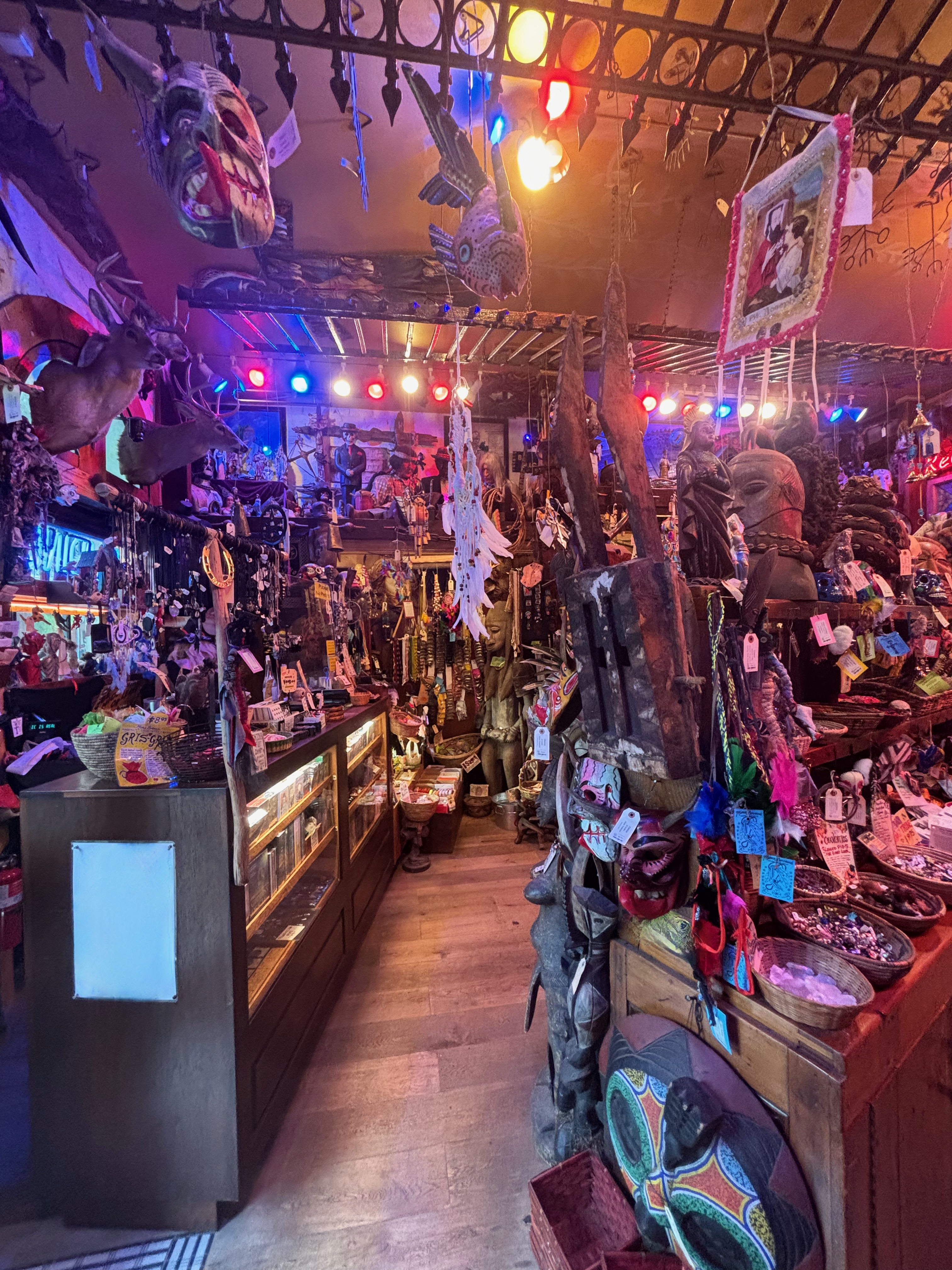
In New Orleans, there’s a spell shop called Reverend Zombie’s House of Voodoo that sells all kinds of spirit items—including the very kinds of offerings you’d buy for Ghost Month. Since the early 1990s, this French Quarter shop has answered every soul who walked in with incense, voodoo dolls, masks, gris-gris bags, tarot cards, talismans, and psychic readings—with many items sourced from local practitioners. Rumor says its founder was named after a mythic New Orleans zombie, adding an extra layer of legend to the ambiance.
Welcome to today’s blog post dedicated to Ghost Month, where I dive into the unseen and ghostly realms.
19.08 million people came to New Orleans in 2024, spending a whopping $10.4 billion and investing in this city’s mystery and charm


The interior of Reverend Zombie’s House of Voodoo looks like a film set
The outside window display

PS. Get fresh posts delivered to your inbox every week:

There’s an attached cigar counter (Dominican, Honduran, Nicaraguan) — a very New Orleans pairing of smoke and sorcery
From 1840–1890, selling charms in New Orleans risked fines, public shaming, or even jail—so dealers hid behind coded ads and back-room sales


In the 1800s—especially between the 1840s and 1890s—mystery shops in New Orleans that sold mojo bags, talismans, and conjure goods often operated quietly, sometimes under the guise of selling herbal remedies, curios or novelties
A pocket doll is a small, hand-sewn figure meant to be carried discreetly in a pocket or purse as a portable charm. Often anointed with spiritual oils, it’s believed to carry its magic with the bearer wherever they go


Locals and practitioners stress that voodoo dolls in these shops are more about channeling energy than sticking pins into enemies
Voodoo dolls—small, rag-doll figures decked in bright fabrics, beads, and feathers are talismans you can carry in a pocket, bag or keep at home—they are believed to foster the energy they represent, whether it’s love, courage, or protection

A gris-gris bag (also called a mojo bag, juju bag or conjure bag) is typically carried on you, tucked it in a pocket, in a bag, pinned inside clothing, or kept under your pillow—close to your body so its energy works directly on you


From roughly 1840–1890, selling a mojo bag could be charged under “fortune telling” or “superstition” laws. Some rootworkers delivered mojo bags in wrapped parcels or tucked them inside innocuous items like tobacco tins or sewing kits

The Cross of Caravaca, a double-barred Christian cross from Spanish Catholic tradition is a protective amulet against evil, illness, and misfortune—worn, carried, or hung above a doorway
A Mexican coconut shell mask is a hand-carved and painted folk art piece made from the hard outer shell of a coconut. Masks guard against evil and are hung by the front door to protect and watch over the home.


Hand-built by ‘Characters Unlimited’ in Nevada, these animatronic fortune tellers blend eerie charm with old-world showmanship—crystal ball, cryptic cards, and all
Spiritual oils are blends of herbs, roots, and essential oils prepared with a specific magical intent, used for Anointing yourself — dab a little on your wrists, temples or pour in the bath

Spirit Offering Bags are small pouches filled with items—like herbs, coins, or tobacco—left at altars or sacred spots to honor and feed spirits —you don’t open the bag. It’s meant to stay sealed so the power of the ingredients stays intact


Cascarilla is made from finely ground white eggshells, sometimes mixed with holy water. It’s a protection tool against negative spirits, bad luck, or curses. Sprinkle it across thresholds, windowsills, or doorframes
Apotropaic magic uses protective objects to ward off harm. Water is believed to trap negative spirits—place the stone in a bowl of water to draw in and hold nightmares.


As far back as the 1820s, New Orleans authorities were already cracking down on public voodoo ceremonies and “superstitious” practices
- Marie Laveau’s House of Voodoo
Contrary to the name, the Voodoo Queen never owned the shop; she walked another path—praying, healing, blending Catholic ritual and Voodoo in homes and Congo Square. The shop is homage, not inhabitation—but you can almost feel her legend lingering in the air.
Video of Marie Laveau’s House of Voodoo in New Orleans
‘Magic soaps’ are often tied to the city’s deep blend of voodoo, hoodoo, Creole, and Catholic folk traditions. Best‑selling soaps include those for love and money attraction—especially formulas involving rudas (herb used for luck) and honey


The Munachi charm, from the Quechua people of the Andes, is a small soapstone carving of a man and woman embracing. In love magic, hair from each partner is threaded through its hole, then placed under a marriage bed or buried at a doorway to anchor the spell’s energy
I watched an eclipse in New Orleans. In Hoodoo and Southern folk magic, eclipses are usually seen as times of intense spiritual power but also danger—a kind of cosmic “crossroads” moment

- Plastic Babies in King Cakes
The tiny plastic baby inside king cakes has medieval roots: baked tokens used during Epiphany to choose a “king” for the day. The Epiphany falls on January 6th and marks the official end of the Christmas season and the beginning of Carnival season in New Orleans (March 4).

During Mardi Gras in New Orleans (Jan 6–Mar 4), King Cakes often hide a tiny baby inside. Whoever finds one in their slice is said to have good luck—and you’ll see King Cakes in nearly every bakery and coffee shop in the city during Mardis Gras

“Witches Brew” Magic Shop in New Orleans sits on a corridor once lined with duelists. Part of the alley was buried under the Supreme Court in 1910
Witches Brew Gallery & Haunted Sanctuary is a hybrid of boutique occult space, art gallery, and spiritual hub
An altar to Papa Legba—the guardian of crossroads in Haitian Vodou and New Orleans Voodoo—is often dressed with offerings like cigarettes, whiskey, coins, and candy, each a gesture of respect to win his favor and open the way between the seen and unseen worlds

An evocative space brimming with curios, dark art, and talismans…
Getting my fortune told at Reverend Zombie’s House of Voodoo!




Leave a Reply