

This post is sponsored by Karen B. Winnick. The review and opinions expressed in this post are based on my personal views.
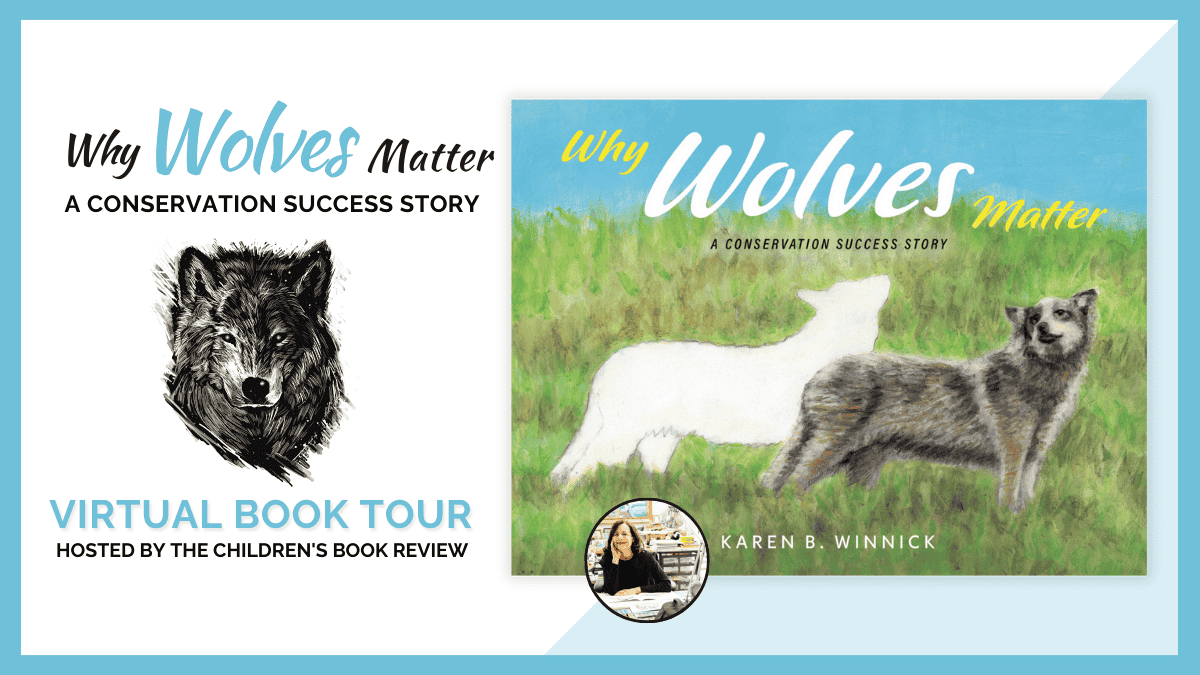
Today, I’m diving into Why Wolves Matter by Karen Winnick, a beautifully illustrated non-fiction book that sheds light on the crucial role wolves play in our ecosystems. Often misunderstood and unfairly portrayed as villains in stories, wolves are actually vital to maintaining nature’s balance.
In this interview, I ask Karen Winnick some important questions about her inspiration, the myths surrounding wolves, and how young readers can get involved in conservation efforts.
This book beautifully explains trophic cascade – a powerful ripple effect in ecosystems where top predators, like wolves, help regulate prey populations. When wolves were removed from places like Yellowstone in the 1926, deer and elk overpopulated, stripping the land of vegetation, which led to soil erosion and fewer habitats for other animals. When wolves were reintroduced in 1995, the landscape healed trees grew back, rivers stabilized, and countless species thrived.
AUTHOR INTERVIEW
What inspired you to write this book? Was there a particular moment or experience that made you want to share the story of wolf conservation with young readers?
As an animal-lover, I was inspired to write Why Wolves Matter because the more I learned about wolves through books and documentaries, the more I developed respect and concern for them. Wolves choose lifetime mates, care for their families just as we do, and are loyal to their packs. They hold an important place in the balance of nature.
The bad rap wolves suffer in children’s literature distresses me. I was compelled to show young readers a different view on wolves and why they matter.
From an old National Geographic magazine, I read Nez Perce Tribal member Dan Spaulding’s quote, “Wolves make the circle whole again.” It sparked the way I wanted to tell this story in a picture book for children.
Wolves are often misunderstood—how does your book challenge common myths about them? What do you hope kids take away about the true nature of wolves?
The misunderstanding about wolves goes back a long way in children’s books. Wolves have been portrayed as the “bad guys”, like in Little Red Riding Hood and The Three Little Pigs. Kids remember the Big Bad Wolf who huffs, puffs, and blows their house down. Terrible!
Partly, this is due to a lack of understanding about the importance of top predators in keeping nature in balance.
Why Wolves Matter is non-fiction. A lot of research went into my story in the hope that I could convey the truth about wolves in a way young children, especially primary school age, would understand.
There’s so much I hope kids take away from my book—empathy and respect for wolves, awareness of the interconnectedness of nature, the importance of preserving habitats, and the crucial role of top predators in keeping the circle whole.
Your book highlights the role wolves play in maintaining a healthy ecosystem. What’s one surprising fact about wolves that you think more people should know?
It might surprise readers to see the devastation caused by the elimination of wolves.
In my paintings, I used whiting out to show the disappearance of wolves and the animals that depended on them. I also illustrated the overpopulation of elk and the destruction of trees and vegetation, visually explaining the difficult concept of trophic cascade at a child’s level.
The illustrations in children’s books are just as important as the words. How did you collaborate with the illustrator to bring this story to life?
All of the paintings in Why Wolves Matter were done by me, using gouache (an opaque watercolor) and acrylic paint. An art director laid out the book’s page design.
I grouped wolves from different photographs to create scenes, hoping they’d come alive on the page—real, with movement. Painting the texture of their fur and the grass was fun.
Whiting out the wolves and the animals affected by their absence was a way to visually emphasize the importance of wolves in the ecosystem.
Conservation efforts have helped bring wolves back from the brink. What can kids (and adults) do to help protect wolves and other endangered species?
Kids can learn about wolves and the issues they face by reading about them. Once they understand, they can discover ways to help. Here are a few ideas:
• Celebrate animal awareness days.
The third week in October is National Wolf Awareness Week. Kids can do a report on wolves and educate their classmates about their importance. The class could even set up a donation jar for a wolf charity.
• Stay informed and take action.
Kids and adults can keep up with news about wolves and write advocacy letters to their state governments to protect them.
Recently, wolves have been reintroduced to Colorado, and the population of wolves in Northern California grew from 44 in 2023 to 70 this past fall.
However, states like Idaho, Wisconsin, and Montana still allow wolf hunting. Writing to state officials—even if you don’t live there—can help.
• Visit wolf sanctuaries and national parks.
Families can visit Yellowstone National Park or a wolf sanctuary that allows visitors to observe wolves in their natural environment.
• Explore educational resources.
The World Wildlife Fund’s (WWF) Wild Classroom offers toolkits to guide kids in helping animals and conservation efforts.
• Start a “Green Club.”
Kids can form a Green Club with friends to take action on goals that help both the environment and animals.
GIVEAWAY
Readers who join us on this virtual tour can win a hardcover copy of Why Wolves Matter: A Conservation Success Story. One lucky winner will receive a signed hardcover copy and a $25 gift card to Amazon. Don’t miss out on your chance to win below!
Click here for the entry form: https://www.thechildrensbookreview.com/why-wolves-matter-a-conservation-success-story-awareness-tour/
ABOUT THE BOOK
Why Wolves Matter: A Conservation Success Story
Written and Illustrated by Karen B. Winnick
Ages: 7-9 | 40 Pages
Publisher: Greenleaf Book Group (2025) | ISBN: 979-8886452846
Publisher’s Book Summary: Where did all the wolves go? The birds, the fish, and the beavers? When the top predator was wiped out, the balance of nature in Yellowstone National Park was disrupted. The circle was broken.
Written in a lyrical style, Why Wolves Matter is an ecological tale that helps children to understand the interconnectedness of all things in the natural world. Once all the wolves were gone, the elk population grew so large that the trees and vegetation on which they fed disappeared, throwing the Park and the remaining wildlife into disarray.
A nonfiction picture book, including a timeline and bibliography, Why Wolves Matter is about the importance of the top predator in nature, how balance was restored in Yellowstone National Park, and how the circle was made whole again—with important historical and scientific relevance for children.
A deeply committed animal person, Karen B. Winnick has created many picture books about animals. She’s a member of an oversight commission for the Los Angeles Zoo, and a member and supporter of many groups working to save animals, including wolves.
PURCHASE LINK
ABOUT THE AUTHOR

Karen Winnick is an author and illustrator of Why Wolves Matter, Can You Spot the Leopard: An African Safari, Good Night, Baby Animals, Mr. Lincoln’s Whiskers, Sybil’s Night Ride, Lucy’s Cave, A Year Goes Round, Barn Sneeze, Cassie’s Sweet Berry Pie, Sandro’s Dolphin and Patch & The Strings. She is the author of The Night of the Fireflies. Her paintings have been exhibited in local galleries, and her poetry has been published in magazines and anthologies. She has also produced a play, Kindertransport, about Jewish children sent to England during WWII.
Karen serves as President of the Board of Commissioners for the Los Angeles Zoo; the Board of Trustees Emeritus at Brown University; the Board of Trustees at the Abraham Lincoln Presidential Library; the Board of Trustees of Fauna and Flora, International and the Board of Governors Syracuse University Hillel. She has also served on the Board of Trustees of The Jewish Museum in New York and the U.S. Holocaust Memorial Museum Council in Washington, D.C.
Karen received her Bachelor of Fine Arts degree from Syracuse University. She also studied in Florence, Italy, at NYU, the School of Visual Arts, and at the University of California, Los Angeles.
For more information, visit karenbwinnick.com.
https://www.instagram.com/karenbwinnick

TOUR SCHEDULE
| Monday, February 17, 2025The Children’s Book ReviewBook Review of Why Wolves Matter: A Conservation Success Story |
| Tuesday, February 18, 2025Me Two BooksBook Activity for Why Wolves Matter: A Conservation Success Story |
| Wednesday, February 19, 2025Satisfaction for Insatiable ReadersBook Review of Why Wolves Matter: A Conservation Success Story |
| Thursday, February 20, 2025Crafty Moms ShareBook Review of Why Wolves Matter: A Conservation Success Story |
| Friday, February 21, 2025icefairy’s Treasure ChestBook Review of Why Wolves Matter: A Conservation Success Story |
| Monday, February 24, 2025One More ExclamationBook Review of Why Wolves Matter: A Conservation Success Story |
| Tuesday, February 25, 2025The TipToe FairyBook Review of Why Wolves Matter: A Conservation Success Story |
| Wednesday, February 26, 2025The Fairview ReviewBook Review of Why Wolves Matter: A Conservation Success Story |
| Thursday, February 27, 2025Cover Lover Book ReviewBook Review of Why Wolves Matter: A Conservation Success Story |
| Friday, February 28, 2025The Starlit PathAuthor Interview with Karen B. Winnick |
| Monday, March 3, 2025Deliciously SavvyBook Review of Why Wolves Matter: A Conservation Success Story |
| Tuesday, March 4, 2025Country Mamas With KidsBook Review of Why Wolves Matter: A Conservation Success Story |
| Wednesday, March 5, 2025Glass of Wine, Glass of MilkBook Review of Why Wolves Matter: A Conservation Success Story |
| Thursday, March 6, 2025Q&As with Deborah KalbAuthor Interview with Karen B. Winnick |
| Friday, March 7, 2025Writer with WanderlustBook Review of Why Wolves Matter: A Conservation Success Story |
| Monday, March 10, 2025Froggy Read TeachInstagram Post about Why Wolves Matter: A Conservation Success Story |
| Tuesday, March 11, 2025Mrs. Makes Reading FunBook Review of Why Wolves Matter: A Conservation Success Story |



Leave a Reply