
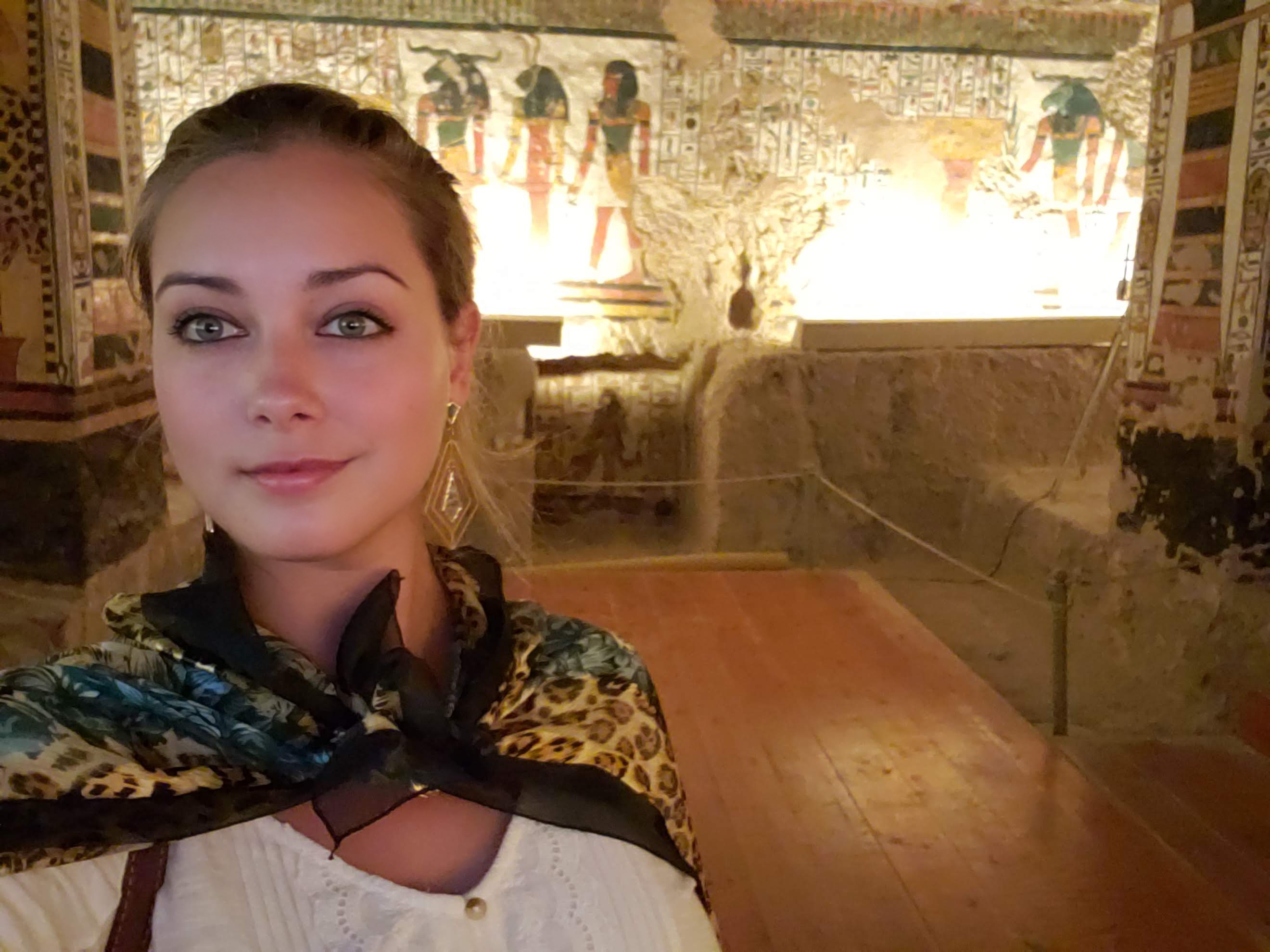

Selfie at the pyramids
The Sphinx

It’s hard to believe that on this day, only six years ago, I was wandering two of the most legendary places in Egypt. In the morning, I stood inside the Valley of the Kings, stepping into the tomb of Tutankhamun itself. By afternoon, I was marveling at Queen Nefertari’s breathtaking tomb in the Valley of the Queens. Both valleys sit side by side on the west bank of the Nile River across from Luxor—a landscape so exotic it still glows in my memory as one of my most unforgettable travel days!
I write about The Egyptian Museum more here.
I write about Tutankhamun’s Tomb here.
I write about Nefertari’s Tomb here.
I write about Hatshepsut’s Mortuary Temple here.
I write about The Temple of Kom Ombo here.
Nefertari’s Tomb in The Valley of the Queens. Nefertari was the Great Royal Wife of Pharaoh Ramesses II


An iconic offering-table scene shows Nefertari in white linen presenting lotus flowers, food, and animals to sustain her in the afterlife
Ancient Egyptians worshiped their gods, performed rituals, and honored Amun, Mut, and Khonsu


Nefertari is led by deities on her tomb walls, including Khnum, the ram-headed god who shaped humans on his potter’s wheel
Karnak Temple was used as a vast religious complex

Colossal statues of Amenhotep III and Queen Tiye (his Great Royal Wife)

✨ Fun fact: Amenhotep III was Tutankhamun’s grandfather. His reign is sometimes called a golden age, marked by peace, wealth, and monumental building projects—including the famous Colossi of Memnon in Luxor, which are also statues of him.


One of the most famous pieces in the Egyptian Museum in Cairo: the Seated Scribe
From the Old Kingdom, the Seated Scribe stares back with eerie, lifelike eyes made of crystal and copper. He sits cross-legged with a scroll, belly rounded from comfort, gaze sharp and watchful. Unlike the perfect pharaohs, he looks startlingly real—as if he might lean forward at any moment to start writing again in the afterlife.
✨ Fun Fact: Visitors are often struck by how “alive” he looks. His eyes are so realistic they seem to follow you around the room—making him one of the most memorable artifacts in the museum.
The museum opened in 1902 and was the first purpose-built museum in the Middle East and North Africa

Protective funerary figures
Tiny mummiform gods, painted in blazing colors and edged in gold, stare out with solar disks glowing on their heads. They once stood in rows around Tutankhamun’s coffins, a wall of guardians ready to strike at anything that dared come close. Each figure held a sliver of divine power, their job clear: protect the boy-king forever, and let no harm touch his body or soul.
✨ Fun Detail
Tutankhamun’s tomb was unique in that it contained four giant nested shrines, each covered in protective texts and lined with figures like these. It took Carter’s team years to carefully dismantle them after the discovery in 1922, because they filled nearly the entire burial chamber.
Ceremonial funerary beds
One of Tutankhamun’s funerary beds sits gleaming in the Egyptian Museum—a golden couch crowned with animal heads of lion, cow, and hippopotamus. Its curved surface mimics simple reed mats, but here it’s frozen in gold, meant not for sleep but for eternity. These beds were never used in life. They were built for death—symbols of rebirth and guardianship, carrying the boy-king safely through the shadows of the underworld.
✨ Fun Fact
Howard Carter was fascinated by these beds because they were unlike anything found in other royal tombs—unique, lavish, and mysterious. They were so fragile that it took years to stabilize them for display.
Gilded shrines of Tutankhamun
When Howard Carter discovered Tutankhamun’s tomb in 1922, he uncovered not a single coffin but four massive gilded wooden shrines, each nested inside the other like giant protective layers. Made of wood covered in gold leaf and richly decorated with hieroglyphs and divine imagery, they served as magical fortresses to guard the boy-king’s body and soul in the afterlife. It took Carter and his team eight painstaking years to document and remove the shrines, so enormous and fragile were these golden walls of protection.
The royal sarcophagi and coffins
In Cairo’s Egyptian Museum, rows of New Kingdom sarcophagi stand behind glass, impressive for their size and decoration. Carved from stone or wood with gilding and paint, they bear hieroglyphs, protective spells, and youthful faces meant for eternity. Notable examples include the coffins of Yuya and Thuya, Tutankhamun’s great-grandparents. Displayed together, they show the evolution of coffin design from simple to elaborate across dynasties.
✨ Fun fact: Many of these coffins were rediscovered in the Royal Cache at Deir el-Bahari (a hidden tomb where priests reburied royal mummies to protect them from grave robbers). That’s why today, so many sarcophagi appear together.

Ancient Egyptian carrying bed
This golden carrying bed once belonged to Queen Hetepheres, mother of Khufu, the builder of the Great Pyramid. It wasn’t for sleeping—it was for display, a gilded litter hoisted high on the shoulders of attendants so the queen never touched the ground. In death, it went with her, buried in her tomb near Khufu’s pyramid to guarantee the same luxury in the afterlife. And there it waited—over 4,500 years—until it was found, astonishingly intact, like it had been left for her only yesterday.
Akhenaten (Amenhotep IV), the “heretic king” of the 18th Dynasty
✨ Fun fact: Scholars still debate whether Akhenaten’s odd body shape was symbolic (to merge male and female qualities of creation) or if he actually had a genetic condition.
On the banks of the Nile
Vista of the banks of the Nile





Leave a Reply